All Hallows Catholic High School

MENU
-
About Us
Information
Curriculum
Catholic Life
-
Useful Links


 DOWNLOAD PROSPECTUS
Curriculum
Music
Curriculum

Staffing
All Hallows Staff
- Mrs. Colclough – Curriculum Co-ordinator responsible for the effective co-ordination and running of the department.
- Mrs Noad – Key Stage 3 Music
Peripatetic Instrumental Teaching Staff
- Piano/ Keyboard / Singing – Janet Calman
- Acoustic Guitar – Carmel Galea
- Flute /Clarinet/Saxophone – Karen Maddocks
- Percussion – Tony Harrison
- Electric Guitar/Rock Band/GCSE Composition workshops – Simon Webster
Accommodation
The Music Department has two purpose built rooms, 4 practice portals, and the Arts theatre and Year 11 centre. The impact of technology within the Music curriculum is well catered for at All Hallows. We have sixteen networked computers all running Microsoft Office, and the vast majority of our students make excellent use of the technological facilities available in the Department. These programmes allow students the opportunity to listen to the music they have composed and then edit and develop their musical ideas. The software also allows students to produce professional quality scores and recordings. The Arts theatre is also used for lessons and is also used for acts of worship, concert rehearsals and performances. The Year 11 centre is also used during Exam periods.
Teaching Strategies
- Time-tabled weekly class/set Music lesson
- Music performances are parts of Acts of Worship and Assemblies
- Individual, paired and group work
- Music performances by pupils and/or visiting musicians /singers
Teaching Groups
Each year group has one lesson each week at Key Stage 3 and 3 lessons each week at Key Stage 4 in Music.
Curriculum
Intent
Music is a universal language that embodies one of the highest forms of creativity. At All Hallows we believe that music education should engage and inspire pupils to develop a love of music and their talent as musicians, and so increase their self-confidence, creativity and sense of achievement. As pupils progress through Key Stage 3, it is our intention that pupils will develop a critical engagement with music, allowing them to compose, and to listen with increasing discrimination.
Implementation
During Key Stage 3, staff will implement and pupils will have the opportunity to:
- Perform, listen to, and evaluate music across a range of historical periods, genres, styles and traditions,
- Learn to sing and to use their voices, to create and compose music on their own and with others, have the opportunity to learn a musical instrument, use technology appropriately
- Understand and explore how music is created, produced and communicated, including through the elements of music -interrelated dimensions: pitch, duration, dynamics, tempo, timbre, texture, structure and appropriate musical notations.
Impact
By the end of Key Stage 3, pupils should be able to:
- Play and perform confidently in a range of solo and ensemble contexts using their voice, playing instruments musically, fluently and with accuracy and expression
- Improvise and compose; and extend and develop musical ideas by drawing on a range of musical structures, styles, genres and traditions
- Use staff and other relevant notations appropriately and accurately in a range of musical styles, genres and traditions
- Identify and use the inter-related dimensions/elements of music expressively and with increasing sophistication, including use of tonalities, different types of scales and other musical devices
- Listen and evaluate with increasing discrimination to a wide range of music
Music Curriculum at KS3 – An Overview
In Music, pupils perform, listen to, compose and evaluate music from a range of historical genres and styles. They learn to sing and have the opportunity to learn a musical instrument, to compose on their own and as part of an ensemble. Pupils will also use technology to enhance their learning in order to progress to the next level of musical excellence. Pupils will understand and explore how music is created, produced and communicated through the musical building bricks and elements: pitch, dynamics, tempo, timbre, texture, structure and musical notation. The foundations laid in KS3 will help pupils to go on to succeed in KS4 and beyond. They will have the knowledge and understanding to enable them to apply their skills and appreciation for music. This will help them to go on to achieve their potential, not just at A Level and in Higher Education but as creative citizens living in a dynamic and interdependent world.
The Principles, which Underpin our Curriculum
Pupils are taught mainly through practical exploration to develop theoretical knowledge.
Through experience and engagement, we believe this improves memory retention and learning. A significant part of the learning is also through creating and evaluation as well as the final performance as this is key to pupil understanding how to refine ideas, implement and use musical knowledge as well as analyse and evaluate for future development. Pupils also learn through research and written assessments, which ask pupils to verbalise their practical experiences, underpinned by theory.
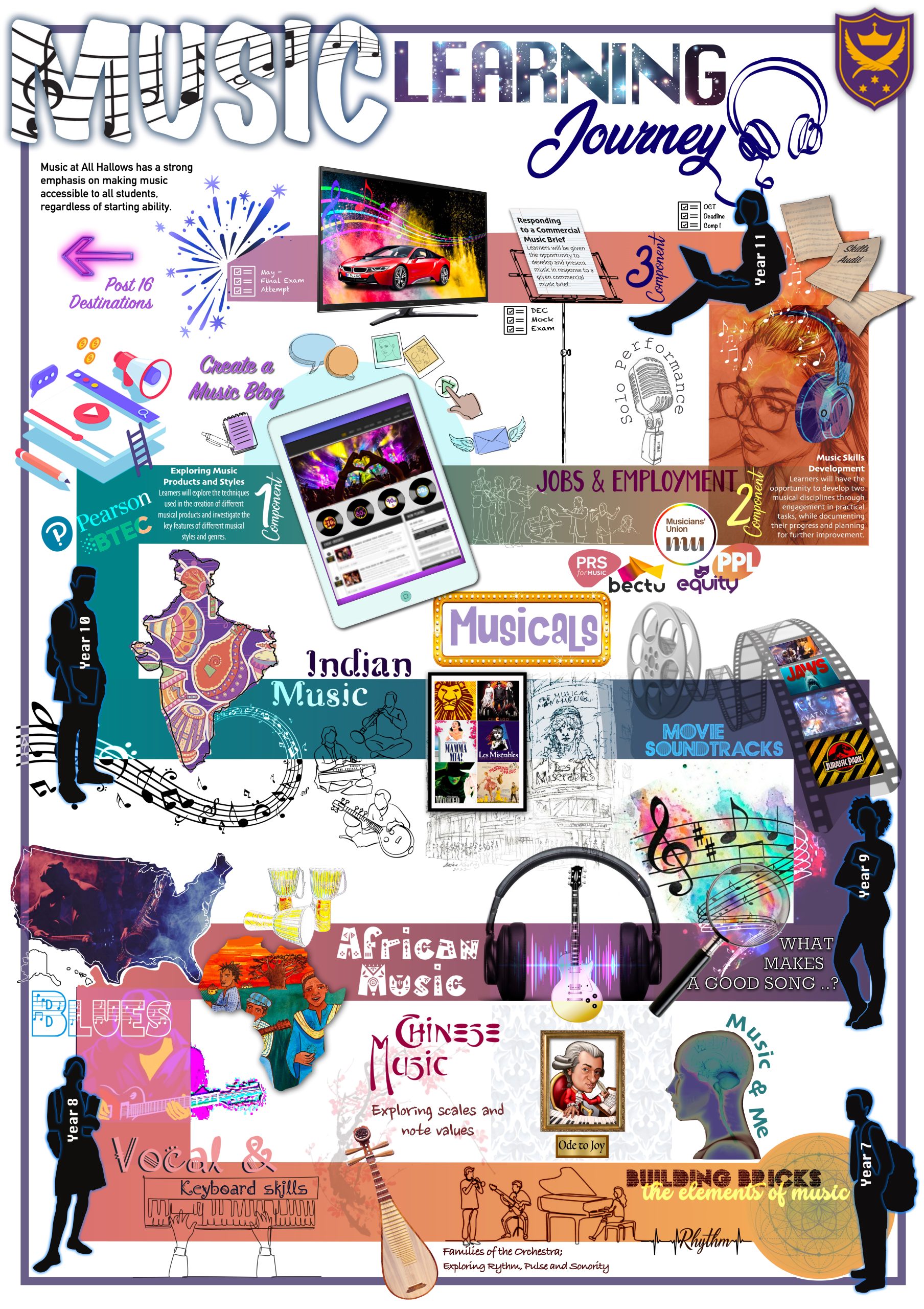
The Music Curriculum is structured to build upon skills and knowledge gained in each topic taught previously and gradually introduces new skills and knowledge. The revisiting of previous skills is consistent throughout all topics, which allow pupils the opportunity to develop and improve. In year 7, the focus is on the fundamentals of performing, composing and evaluating music and in year 8 this is developed further focusing on developing musical ideas and evaluating musical genres in more depth. In year 9 pupils continue to develop their performing and composing skills but with a bigger emphasis on the theoretical side, looking at form and structure and composers and musicians. Within the GCSE, these skills are applied and developed to meet the specification in order to create well-educated musicians and fantastic performers.
Within all topics throughout the 5 years, pupils understand the importance of Personal Development - mutual respect, listening to others’ ideas and beliefs. This is often taught through presentation of performance and how to be a respectful audience or ensemble member. Socially, pupils engage every lesson with each other often in groups, understanding the way in which they should work as a team and receive feedback on how they rehearse and create together. Opinion and debate is encouraged within music, often encouraged through constructive criticism. Culturally, pupils gain experience of art, drama and music along with the experience of theatre and live performance.
We aim to ensure cultural experience is gained for all pupils by bringing performances to the classroom. Some pupils may not have experienced live performance before and through others performing, videos and modelling this should close the gap to ensure we are bringing this to pupils within the classroom.
Music focusses on developing pupils’ self-awareness as a team worker, communicator and leader and therefore equal focus is put on the rehearsal process, as is the final presentation of performance. The end goal is for pupils to be able to gain transferable skills suited for later life and be able to ‘hold their own’ in social situations. Group work is key to this and hugely encouraged within our Music curriculum. Pupils should become culturally aware through the schemes of work offered and the reference made to wider context, as often music is a medium in which historical and cultural events or styles are explored.
Along with gaining vital transferable skills for any job or career (communication, leadership, teamwork, problem solving, confidence), music encourages pupils to express themselves confidently. This is vital for all careers. Industry work is often discussed within schemes of work, for example within ‘Hip –Hop’, Rappers, songwriters, producers and engineers, along with conductors and instrumentalists within ‘Instruments of the Orchestra’ and ‘Musical Forms and Structure’. There are of course careers directly linked to music such as, music therapy, music journalism, radio broadcasting, sound technology, event management, Djing, composing, music production, teaching, performing, audio engineering just to name a few. All of these jobs would need an understanding of audience and therefore this is often the focus of schemes of work, discussing what the audience would expect and how to fulfil those expectations through communication and meaning.
Subject teachers are practicing artists within their specialism, and passionate about the Arts. We stay up to date with recent developments and although a small department, we have strong community network, via local primary schools, Diocesan network meetings, drama and music community hubs, such as Lancashire Music Service Hub and ISM and Music Mark, and social networking such as Instagram.
Curriculum Features
The curriculum is structured based on the expectations for GCSE & A Level Music; key concepts and skills required by the end of these courses are fed down into schemes of work from Year 7 upwards. This is designed to raise expectations and standards from the start of Key Stage 3 and ensure that musical knowledge is being understood both practically and theoretically. Year 7, 8 and 9 will study various musical genres, (historical and cultural) and through these different cultures and styles will explore, develop and refine their musical skills. Each project will focus on one or more of the 3 subject specific skills – Performing, Composing, Listening and Evaluating, so that over the key stage students will return to these concepts enabling them to build and advance their knowledge and skill set further as they progress through the Key Stages.
Year 7
During Year 7, students explore the elements of music through a variety of mediums and genres. Students will learn to analyse and describe the music that they listen to using music specific vocabulary. They will compose and perform in groups with the focus on effective music making and transferable skills. This year provides the opportunity for students to maintain and develop the invaluable skills of learning by ear, notation reading and rehearsing and performing as part of an ensemble. Students will be given the opportunity to compose and perform using their voices, tuned and unturned percussion, ukuleles, guitars and keyboards.
Year 8
In Year 8 students will continue to develop their skills in listening & evaluating, performance and composition. They will develop their understanding and musical awareness through a range of workshops using their voices, ukuleles, classroom percussion, guitars and music technology. They will compose and record their own music using a range of notation including staff notation, chord and lead sheets. They will also learn about different musical contexts, and perform in a variety of settings and genres. Students will explore different timbres, structures, and key characteristics, alongside using the musical elements to create music for a specific medium.
Year 9
In Year 9 students will develop their ability to recognise, analyse and demonstrate a range of music techniques; the aim of which is to produce successful and polished pieces of work, in preparation for the GCSE Music course. They will analyse, compose and perform music from different cultures, genres and musical traditions; learning how to plan and develop their compositions to create stylish and idiomatic pieces. They will also have the opportunity to perform at a higher level in groups and on their own, developing their skills as musicians and again preparing the way for the GCSE Music course.
Intent
Pupils will build on their previous knowledge and skills through performing, composing and listening. They should develop their vocal and/or instrumental fluency, accuracy and expressiveness; and understand musical structures, styles, genres and traditions, identifying the expressive use of musical dimensions. They should listen with increasing discrimination and awareness to inform their practice as musicians. They should use technologies appropriately and appreciate and understand a wide range of musical contexts and styles. They will compose 2 pieces, one set to a brief and will perform 2 pieces, one solo and one in ensemble.
Implement
During Key Stage 4, staff will implement and pupils will have the opportunity to:
- Perform, listen to, review and evaluate music across a range of historical periods, genres, styles and traditions, including the works of the great composers and musicians
- Continue to learn to compose music on their own to set briefs given
- Understand and explore how music is created, produced and communicated, including through the inter-related dimensions: pitch, duration, dynamics, tempo, timbre, texture, structure and appropriate musical notations.
- Learn to complete a Blog for Component 1
- Complete the skills audit for Component 2
Impact
By the end of Key Stage 4, pupils should make significant progress and be able to:
- Play and perform confidently in a range of solo and ensemble contexts using their voice or by playing instruments musically, fluently and with accuracy and expression
- Compose with creativity, accuracy and suitability to a set brief
- Understand and be able to read and write using musical notation
- Identify and use the inter-related dimensions of music expressively and with increasing sophistication, including use of tonalities, different types of scales and other musical devices
- Listen to unheard extracts and be able to answer effectively exam questions which have been worked on in class
- Develop a deepening understanding of the music that they perform and to which they listen from and its history.
Curriculum Info
- Music Year 7 Curriculum Map
- Music Year 8 Curriculum Map
- Music Year 9 Curriculum Map
- Music Year 10 Curriculum Map
- Music Year 11 Curriculum Map
Extra-Curricular Music
Participation in extra-curricular Music activities enriches the core curriculum for Music and allows pupils the opportunity to share interests and experience performing with others.
- Music Performance group for each Key Stage group
- Singing and Instrumental – Drums, Piano, Keyboard, Woodwind and Guitar lessons with LMS –Lancashire Music service
- Community networks – LMS Instrumental groups for County players
- Choirs in school and an adult All Hallows Community Choir
- Guitar Ensemble
- Rock Guitar club
- Jazz Band
- Ukulele group
- Assemblies – Christmas and Easter –Chaplaincy team
- Year group Assemblies
- Transition days with Primary feeder schools
- Workshops with UCLAN and Runshaw and Newman FE Colleges
- Strong links with Alumni

